Anime columnist Andrew Osmond considers the 2 comedies by the beloved studio: this summer’s ‘City The Animation’ and its predecessor from 2011, ‘Nichijou: My Ordinary Life;’ weighing them up, he argues newer isn’t always better.
This week, I’m writing about two comedy anime series that are, by any sane standard, oddball and eccentric. They’re City The Animation, a just-ended series that you can see on Prime Video, and its 14 year-old predecessor, Nichijou: My Ordinary Life, which streams on Crunchyroll.
City isn’t a conventional “sequel” to Nichijou; they each have different settings and characters. Nonetheless, they’re intimately linked, being animated by the same studio – the beloved Kyoto Animation – and based on strips by the same artist, Keiichi Arawi. Moreover, they share the same format. Both shows are sketch comedies, blending absurdist humor with an underlying sweetness – the sweetness sets them apart from most live-action exercises in the format. Or maybe that’s my British bias: the sketch shows I know, from Monty Python to Little Britain, slip into darkness and grotesquerie.
Writing about an oddball anime brings up its own issues, given pundits used to treat “weird anime” as a tautology, and some still think it is. These days, calling anime “strange” outside Japan can be incendiary. It raises issues of Orientalism, Othering and furious denunciations of Lost in Translation. Still, I’ll always treasure foreigners’ reactions to, for instance, a sweet potty-training anime video that makes people’s jaws drop. If you’re wondering, the video’s no spoof, being spun off from a massively popular preschool anime in Japan.
But plainly many anime and manga creators want to make something strange and absurd: a meeting with God in Masaaki Yuasa’s Mind Game or a mad magic parade in Satoshi Kon’s Paprika. Among the deluge of new TV anime, there are shows called Nyaight of the Living Cat (about an apocalypse of cute kitties) and Reborn as a Vending Machine, Now I Wander the Dungeon. Even “mainstream” anime such as Dragon Ball, One Piece and Demon Slayer look deranged if you’re not a fan plugged into their tropes.
So, what can Kyoto Animation’s City and Nichijou offer that’s different from them? I’ve watched through both shows for the first time in recent weeks, and while City is intermittently impressive, the show I’d wholeheartedly recommend is the older Nichijou. It’s far funnier than City, more delightful and accessible, for all its oddness. Indeed, for any reader who was intrigued by City but who found it gratingly uneven, then I recommend Nichijou to see how it should have been done.
The two shows’ mix of elements is unusual even for anime. As mentioned, they’re sketch shows; a succession of absurd scenes and set-pieces, usually with different characters from one vignette to the next. However, they’re set in a continuing world where the characters run into each other. Most characters are human, which doesn’t stop the animals from stealing a scene with their walk-ons. For all the sketch-to-sketch silliness, the characters have arcs and storylines; the comedy can go in Pythonesque digressions but always comes back to normality. There’s no true cruelty or sharp edges; the shows have the fundamental kindness often associated with Kyoto Animation.
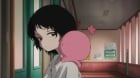
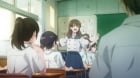
For now, I’ll focus on Nichijou. Most of its leads are schoolgirls, linking the show to other anime of the time, such as Kyoto Animation’s then-recent K-ON! The girls’ cuteness, though, is secondary to their chemistry, which is funny in mundane and hysterical situations. One strand involves a trio of friends. There’s the ever-sloppy Yuko, always forgetting her homework, and the studious Mio, given to doodling sexy pictures of a male student (one wonders if Nichijou was one of the anime watched by Domee Shi, director of Pixar’s Turning Red). Mai is the funniest – a deadpan, imperturbable type who maddens Yuko with her inscrutable jokes. The jokes are often lost on English speakers, but she’s funny all the same.
Yet many Nichijou viewers may prefer an initially separate domestic strand, involving parent and child figures. Well, kind of. Hakase is a preteen girl in a lab coat, while the motherly Nano is a girl robot who Hakase’s somehow built. At first you wonder if this is some Calvin and Hobbes depiction of a child’s imagination, but this is just how things are in Nichijou, down to the clunky key in Nano’s back. Of course, that doesn’t stop the story being allegorical: the key stands for all Nano’s insecurities about the wider world, especially in the show’s second half when she goes to school (which is more than Pinocchio ever managed).
There are more characters – a talking cat, for example, who tries to be an adult authority figure to Hakase and Nano, but ends up the eternal fall guy. These characters have enough grounding to register outside the often-madcap set-pieces, dazzling though they are. There are frantic, hilarious cartoon chases, whose awesome energy rivals Dan Da Dan. There are small, exquisite vignettes, such as a sleepless Yuji’s frantic battle to catch summer mosquitoes in her room. There are friends’ arguments that go thermonuclear, and treasurable exercises in lunacy, such as the one below.
As the clip demonstrates, much of what makes the series is the often-glorious music, by Yuji Nomi, a protégé of Ryuichi Sakamoto. Also integral to Nichijou are the beautiful, tranquil shots of the world quietly going on elsewhere, a riverbank or a playground, away from the hysteria. Lasting a few slow seconds, these cutaways are what film critics would call pillow shots, as used by the Japanese live-action director Yasujiro Ozu. They’re mostly silent; Nichjou’s soul is in the rhythm of its sound and quiet as much as the flow of its images. Giving Nichijou a laugh track would be as ruinous as Miramax giving voices to the title duo in Richard Williams’ The Thief and the Cobbler.
While Nichijou might seem to show static situations, it changes over its 26-part length. As mentioned above, Nano finds herself able to join the other characters in school from the midway point. From there, longer storylines emerge, and the gags get noisier. Here’s a set piece from the second half of the series, showing Mio’s reactions when her embarrassing drawings are about to be exposed. While Nichijou’s animation is far above most TV anime’s, what’s more important is the invention of the visual narration; Nichijou switches styles and approaches from shot to shot with an illusion of blithe spontaneity.
Nichijou was helmed by Tatsuya Ishihara, one of the mainstays of Kyoto Animation. He’d already directed many of the studio’s most remembered series in the 2000s – Air, Kanon, Clannad and The Melancholy of Haruhi Suzumiya. Following Nichijou, he’s been linked with the ongoing Sound! Euphonium franchise, about a school orchestra. Having seen much of his other work, I couldn’t feel any “personal” continuity between it and Nichijou, of the kind that’s palpable in the work of another of Kyoto Animation’s directors, Naoko Yamada. That’s no criticism of Ishihara’s work, but his lack of a transparent signature may explain why he hasn’t gained the following Yamada has.
Yamada herself directed two of Nichijou’s individual episodes, 5 and 17. I didn’t find them outstanding within an excellent series, although Episode 17 has a bold sketch, entirely wordless, with the girls trying to complete a house of cards: it’s here as of writing. The concept is beautiful, but the execution is so protracted that its artistic ambitions start to irritate. I was more impressed by the faux-melodrama of a “stuck in an elevator” scene in Episode 8; as of writing, it’s here with German subtitles.
I should also add that what we think of as the “Yamada style” owes a huge amount to her own frequent collaborators, writer Reiko Yoshida and composer Kensuke Ushio, neither of whom were involved with Nichijou.
Over then to Nichijou’s successor, City The Animation, which was screened over the just-finished summer season. It ran 13 episodes, compared to Nichijou’s 26, though the City episodes run a few minutes longer. The director this time is Taichi Ishidate, another veteran of Kyoto Animation, who was Assistant Director on Nichijou. Ishidate has a plethora of animation and storyboard credits on the studio’s titles going back two decades; he also directed almost all of the romantic saga Violet Evergarden.
As I mentioned before, City shares the same sketch format as Nichijou, and I watched the two series more or less side-by-side. From the start, I found City less involving and less funny. That’s despite its obvious assets, such as a delightfully simple, bold color palette that would make the show stand out to a channel-hopper, and its sometimes-delirious levels of elaborate spectacle. That’s especially true of two episodes: Episode 5, involving a frantic escalation of split-screens, and Episode 9, which has a densely detailed wacky race (excerpted here as of writing).
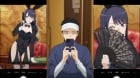
There are outstanding moments; I especially liked the deranged college theatre troupe which consists mostly of animals; the loyal butler who snags anyone his mistress wants; and a lovely horserace skit in which a crowd reacts hysterically to an unseen contest. But I found it hard to feel much comedic chemistry between City’s characters, whose noisy emoting felt more raucous than funny. I’ve seen online raves over Episode 5, in which the action splits dizzyingly into more and more screens, and it’s original and memorable. But it has the same problem as Nichijou’s house of cards sketch. In its strivings to impress, it becomes exhausting to watch, and the comedy drains away.
As of writing, Arawi’s source City manga is still running, but he’s also resumed drawing Nichijou (which ostensibly ended in 2015, but started again in 2021). I know which strip I’d rather see continued by Kyoto Animation.