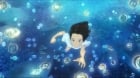
Anime columnist Andrew Osmond explores the fringes of the iconic ‘God of Manga’s work: strange short films, magnificent fantasy sagas and doodlings on Disney.

Any foreign visitor to Tokyo using the city’s dense public transport will notice the jingles playing on station platforms when a train arrives or leaves. I’m amused to think of film fans arriving at Tokyo’s Ebisu station and wondering why they’re serenaded by the theme from 1949’s The Third Man. Answer: because the tune is often used on advertising by the local beer company, Yebisu.
More relevant to anime, this summer I visited Seiseki Sakuragaoka station in the Tama Hills, a Tokyo suburb. I chuckled to hear the platform loudspeaker playing “Country Road.” The area round the station inspired the scenery in a lovely 1995 Ghibli film called Whisper of the Heart… which memorably used “Country Road” as a motif (here’s a key scene in Spanish).
Then there’s Takadanobaba station. Like Ebisu, it’s on the Yamanote Line, which is perhaps Tokyo’s busiest. The platforms of Takadanobaba ring with a tune you may know even if you’ve never watched the source series – the TV animation Astro Boy, or Mighty Atom (Tetsuwan Atom) in Japanese.
Atom is a hero, an android boy with Superman strength and machine guns in his bottom. But just reflect on his name for a moment. Atom debuted in comics in 1951, a symbol of innocence and hope... and the character was created in Japan, barely five years after artificial suns burst over Hiroshima and Nagasaki. To call such a hero Atom suggests an audacious creator, with a strongly individual, fearless vision.
And that vision went way past Atom. Right outside Takadanobaba station (the “Waseda Exit”), you can see this creator’s characters proudly assembled in a giant mural.
I’m talking about Osamu Tezuka, titan of Japanese comics or, as he’s commonly called, the “God of Manga.” He rose to comic stardom even before Atom. His breakthrough was in 1947, when he drew the adventure strip “New Treasure Island” (written by Shichima Sakai).
Soon he was writing and drawing strips, but one medium wasn’t enough for him. He had a childhood fascination with animation, and in 1961 he founded his own studio, Mushi Production. This made the monochrome Astro Boy TV cartoon that was exported to America in 1963, as well as the color Kimba The White Lion from 1965 (called Jungle Tatei or Jungle Emperor in Japan).
Both titles were hits, and Tezuka sometimes returned to them in later years, but they reflect only a small fraction of his output. He produced work at a boggling rate from the 1950s through to his death from stomach cancer in 1989. Even then the story goes that his final words in the hospital were a plea: “Let me work.”
Tezuka fans highlight his wide-ranging epic strips such as Adolf (aka Message to Adolf), a political thriller; Tezuka’s multi-volume life of Buddha; and his period supernatural adventure Dororo. Then there’s Phoenix, a cycle of cosmic stories musing on life, the universe, and everything.
Thankfully, there are newcomer-friendly introductions to Tezuka in English. They include Helen McCarthy’s lavishly-illustrated “The Art of Osamu Tezuka” and Frederik L. Schodt’s compact “The Astro Boy Essays,” which focuses on the title character. For readers interested in how Astro-Boy and Kimba came to America, that was thanks to the late Fred Ladd, who localized them. You can find a vintage interview with Ladd on this site, and I summarize his story here. But, Ladd’s full account is in his book “Astro Boy and Anime Come To The Americas,” co-written with Harvey Deneroff.
For anyone coming to Tokyo in the coming weeks, there’s also a small but excellent overview of Tezuka’s work at the Tokiwaso Manga Museum. The museum itself is fascinating – it’s a reconstruction of a 1950s apartment building where numerous famous manga artists lived, including (briefly) Tezuka himself. It’s near a subway station (Ochiai-Minami-Nagasaki on the Oedo line), or a quick bus ride from the overground Sugamo station.
The exhibition, running to November 24, is called “Save The Glass Earth,” and it displays art from numerous Tezuka strips, accompanied by English explanatory text. You can examine it fully in half an hour, but I can vouch that it’s a great introduction to Tezuka, as I’m still a Tezuka newcomer myself.
I’ve read a lot about Tezuka, and seen quite a few titles related to him, but I don’t feel I’ve ever dove into his work “proper.” As I grew up in England in the 1970s and ‘80s, Astro Boy and Kimba weren’t part of my childhood. The 1960s cartoons don’t seem to have ever reached British television, though later remakes may have.
There weren’t any hefty DVD sets of Astro Boy and Kimba in Britain as there were in America. I went to a four-day season of Tezuka animation in London in 2008, but even there I felt I was bouncing off a massive corpus of work, never seeing it in the round.
Still, I’ve seen many “peripheral” Tezuka anime over the years. One of the most satisfying is Pluto, available on Netflix. This is an eight-hour cinematic epic set in the Astro Boy universe, but it’s accessible if you’ve never seen Astro Boy before. I enthused about it in a previous column. It’s a reinterpretation of Tezuka’s work, written by a newer manga star, Naoki Urasawa. It’s also a transparent comment on world events after Tezuka’s death, specifically on America’s post-9/11 invasion of Iraq.
It’s worth saying, though, that Tezuka was quite capable of such commentary himself. It’s easy to think of Atom/Astro Boy as a cute “cartoon” hero, but Tezuka could use him for some extremely grave ends. His adventures are mostly set in the future, but there’s a 1967 Tezuka strip called “The Angel of Vietnam,” where Atom finds himself in our (then) present-day world. In the strip, Atom defends a village of helpless Vietnamese peasants against American bombers. But he runs out of power, the Americans return and massacre the villagers. Imagine if this summer’s Superman film had ended like that.
The best-known posthumous tribute to Tezuka, though, isn’t Pluto, but 2001’s Metropolis, a cinema feature directed by Rintaro (real name Shigayuki Hayashi). He worked under Tezuka at Mushi Production in the 1960s, directing Astro Boy episodes. His film is a sci-fi adventure inspired by Fritz Lang’s silent Metropolis and Tezuka’s early adventure strips, juxtaposing Tezuka’s retro-designs against CG backgrounds.
Visually, it was a much more successful mesh of aesthetics than Don Bluth’s Titan A.E. the year before, and many of its images are admirable. However, I find much of its story a rambling bore. It was scripted by Katsuhiro Otomo, whose Akira and Steamboy ramble too, but they have an emotional cohesion which Metropolis lacks.
I prefer the 2009 Astro Boy film, which is unloved critically and commercially and isn’t actually anime. It was made in CG by Hong Kong’s Imagi Animation; the studio shuttered after the film flopped. Imagi’s version adds some interesting tweaks – there’s an existential strand about whether Astro is a human child resurrected in a robot body or a copy of that child, moving into similar territory to this summer’s The Summer Hikaru Died. There’s also irreverent humor with rebel robots who smack of Monty Python, and a suggestion of Pluto politics – the villain is a President planning a meaningless war.
Astro Boy was directed and co-written by Britain’s David Bowers, fresh from directing Aardman’s CG Flushed Away. However, I felt his humor had other roots – Bowers previously worked at Britain’s Cosgrove Hall studio on its wonderful TV cartoons, Dangermouse and Duckula. Reviewing the film for Britain’s Sight & Sound magazine, I acknowledged it pilfered from other (non-Tezuka) films, that much of its animation was functional, and that it was no competitor for, say, Pixar’s Wall-E. But I found it “a very decent junior SF adventure.”
Many AWN readers may find the short Jumping, above, a more congenial introduction to Tezuka. The clip I’ve embedded shows the film’s first half, from the official channel of Tezuka Productions. However, there are a plethora of “full” copies of Jumping online, and of Tezuka’s other short works. Tezuka himself acknowledged Jumping was inspired by Ferenc Rofusz’s Oscar-winning animation The Fly (1980), but his film is its own creature, and I’ll always prefer it.
Its simple premise delights. An unseen protagonist magically jumps higher and further with each bound, till they’re crossing continents and oceans. Its conceptual elegance and cheeky wit reminds you of hypnotic picture books that entranced you as a grade schooler. The climax toys with real-world darkness, but it dodges facetiousness or finger-wagging. Instead Jumping saves itself with a trickster simplicity that Bugs Bunny would approve.
Tezuka’s short animations go back to his 1962 film Tales of a Street Corner, though at 39 minutes that was a featurette and a chore. I saw it together with an esteemed animation critic who found it excruciating, which may have colored my reactions to it ever since. But I found another of Tezuka’s shorts a revelation: 1964’s Memory (no relation to the anthology feature Memories in 1995).
Memory’s sensibility and humor smack of Bob Godfrey, while its irreverent treatment of war traumas seems to foresee the “Barbenheimer” phenomenon 60 years on. Here’s the opening:
Tezuka’s later shorts play recursively and fannishly with the heritage of film and animation. 1985’s Broken Down Film is great fun; its obvious antecedent is Chuck Jones’ Duck Amuck, but Tezuka is more enamored with the mucky materiality of the film medium. Here’s the opening:
Then there’s 1987’s Legend of the Forest, which I remember watching in a cinema in awe. Some viewers may find it comically overblown, complete with a Tchaikovsky soundtrack, but the film’s grandiloquence moved me, much like its obvious inspiration, Fantasia. It’s stuffed with fanservice for cartoon buffs – references include Fantasmagorie (by Emile Cohl), Gertie the Dinosaur, Felix the Cat and Flowers and Trees. Here’s the opening, before the images start to move (the full film runs 30 minutes).
The film was originally meant to have four “movements,” but the 1987 film just has two, which are confusingly designated the first movement (running 20 minutes) and the fourth movement (10 minutes). To be honest, nearly all the film’s impact comes from the first movement, which is about a hero squirrel; the rest is an addendum.
But I want to point up that following Tezuka’s passing, his son Makoto Tezuka directed what had been meant to be the third movement of Forest, and it was released in 2014 as a separate 12-minute short called Legend of the Forest – Part 2. Gorgeous and amazing, it deserves far more recognition than it has. Here’s a brief extract:
It feels like an especially good segment of Fantasia, and indeed Tezuka often stressed his love of classic Disney. In an infamous essay published when Tezuka died, Hayao Miyazaki claimed Tezuka was ruled by a Disney inferiority complex, “a fear he would never be able to surpass the grand old man [Walt].” Heaven knows what Tezuka would have thought of the storm that broke only a few years after his death, when hordes of anime fans furiously insisted that Disney’s The Lion King had stolen from Tezuka’s lion cartoon, Kimba.
That’s a subject for another article; there’s a comprehensive account at The Hollywood Reporter. I’d only add that Tezuka ripped off Disney decades before Lion King – look at Astro Boy’s very first episode around 19-30 and tell me that’s not Dumbo with robots. On a personal note, I was once in a Tokyo bookshop when I came across a beautiful Tezuka-illustrated edition of 101 Dalmatians by Dodi Smith, published in Japan in 1972. It wasn’t a Disney product, but it might as well have been. Here’s an internal illustration:
Tezuka had already drawn strip versions of Bambi (in 1951) and Pinocchio (in 1952) though the latter, at least, wasn’t Disney-licensed. I’ve only seen extracts from them, but I’m morbidly fascinated that while Tezuka’s Pinocchio looks like Disney’s, Tezuka includes a scene from the original 19th century Italian story that would have been unimaginable in Disney’s film. It’s where villains take the puppet boy and hang him from a tree, which author Carlo Collodi originally meant to be the end of his story. Perhaps only a Japanese creator could unite Collodi’s and Disney’s versions so blithely.
The last examples of “peripheral” Tezuka work I want to cover go beyond anything Disney could do. You may have heard of his 1970 Cleopatra feature film (trailer), if only because American marketers had the bright idea to rename it Cleopatra, Queen of Sex. But I much prefer its predecessor, the 1969 feature A Thousand and One Nights (trailer), which Tezuka co-wrote.
As with Legend of the Forest, I remember seeing the film in a cinema and thinking this was a true discovery, as enjoyable for its Harryhausen-style mythical monsters as it was for its arty eroticism and unclean fun. The video extract below is possibly NSFW, though only mildly.
Even in its cult niche, though, A Thousand and One Nights has been overshadowed by the superior Belladonna of Sadness (1973), a non-comedy adult film made by Tezuka’s studio without his involvement. Still, you can find adult touches in “Tezuka” anime made even now. The last title I want to point to is the 2023 miniseries Phoenix: Eden17, based on part of Tezuka’s Phoenix story cycle that I mentioned earlier. The anime was serialized online, though there’s also an alternative cinema edit called Phoenix: Reminiscence of Flower.
Like many of Tezuka’s stories, Phoenix: Eden17 has tragedy, suffering, and really weird twists. It starts as the story of a man and woman travelling to an alien world, determined to live there (and even more determined when the woman becomes pregnant). Then things get bad, and then very bad, till finally a character is raging at the heavens, asking why he was even born.
That’s followed by a development so outrageous that some viewers may walk away there. Suffice to say a young man finds himself embracing a naked woman who’s the double of his lost mother. “Your heart was longing for that woman,” this beauty pronounces. “So, I took on the shape of her.” And you thought Ghibli’s Boy and the Heron was Oedipal.
From there, Eden17’s story unravels, becoming less involving and coherent, till its last scenes feel like a mockery of storytelling. But it’s so odd and charming that the anime itself becomes a loveable character. In one sequence, we journey through space in a magic rock, piloted psychically by an alien child with green hair and a fleshy antenna. It’s captivatingly retro, like old sci-fi animated films like Time Masters, or black and white Doctor Who.
And as you may have noticed from the trailer, this perverse oddity was released worldwide on Disney+! Well, except in America where it’s on Hulu instead. But it still feels like the end of a very long cross-cultural odyssey, from Tezuka’s “Bambi and Pinocchio” strips, through the Lion King controversy and the Fantasia hubris of Legend of the Forest, to a reconciliation between Tezuka and Disney in deep space.