Anime columnist Andrew Osmond looks at 2 anime from the noted director – a film and a TV series – that are both set against summer sun, are easy to overlook, and are very good.
This week, I’m discussing two anime, a film - Children of the Sea - and a TV series - Summer Time Rendering. They’re both made by the same director; they’re both very good; they’re both set splendidly against summer sun and sea; and they’re both easy to overlook, even though they’re available on online platforms and were released in the last six years.
First, an introduction to their director.
Ayumu Watanabe
According to a profile on the GKIDS page, Watanabe began his career as an animator in 1986 when he turned 20, although it’s hard to find credits for him going back that far. Perhaps he used (or now uses) a pseudonym. What is clear is that a lot of his work in the 1990s and 2000s was for the endless children’s franchise Doraemon, about a friendly robot cat, which is huge in Japan, but little known in Anglophone territories.
In particular, Watanabe had directing, writing and storyboarding credits on the 2006 Doraemon film Nobita’s Dinosaur, which is significant within the franchise, being a remake of the very first Doraemon cinema film from 1980. Here’s the trailer for the 2006 film.
In the 2010s, Watanabe would have a string of directing credits on anime well beyond Doraemon. His credits include the long-running TV series Space Brothers (2012-2014), followed by Ace Attorney from 2016. The latter may be a red flag for some readers; it was adapted from the popular Capcom game series, but a cursory search suggests the anime was badly received by many of the games’ fans.
Of Watanabe’s series that I’ve seen, Mysterious Girlfriend X (2012) was an amusingly bizarre romcom with a shocking-sounding premise: a schoolboy who is linked with the titular enigmatic girl after, ahem, tasting her saliva. “At best it’s actually touching,” I wrote in a magazine review, “as the saliva comes to stand not just for gooey mechanics of sex, but for all the communications in a budding romantic relationship. By the later episodes, with a witty, well-played love rivalry and our Romeo and Juliet in crisis, you could be watching an old-school anime romcom… only a bit wetter around the mouth.” It doesn’t seem like it’s available to stream these days, although home formats are available.
Watanabe’s After The Rain (2018) was more contentious, as the series deals with the unspoken attraction between a 17 year-old schoolgirl and the bumbling fortysomething owner of the café where she works. However, even more than Mysterious Girlfriend X, the series is far more chaste than it sounds. There were no such issues with Komi Can’t Communicate (2021), a good-natured school comedy about a chronically introverted girl, a kind boy doing her best to support her, and the wildly eccentric characters surrounding them.
Apart from Children of the Sea and Summer Time Rendering, Watanabe’s most significant work may be the lovely feature film Fortune Favors Lady Nikuko, also released in 2021. I’d count it as a post-Ghibli film, which draws not on Hayao Miyazaki but rather on the works of Isao Takahata, especially his 1991 film Only Yesterday. I recommend Nikuko highly, but I won’t cover it further here, as I’ve reviewed it and written a background article elsewhere.
Children of the Sea
The film Children of the Sea predates Lady Nikuko, being released in 2019. It’s a film of two halves. One of those halves is, again, a post-Ghibli film and a radiant one – gloriously detailed and animated, filled with wonder and mystery, with an acutely observed girl lead and a superb score by the Ghibli composer, Joe Hisashi. It’s stunning, though it could be overshadowed by Children’s second half, which is much more divisive. I’ll discuss that further down.
The film starts by the ocean. The setting is real – the coast near the tiny isle of Enoshima, a favorite tourist spot near Tokyo. Our protagonist is Ruka, a high schooler bursting with energy as the summer holiday starts. But she’s slapped down - she fights with a girl in her sports team and is banished by her teacher.
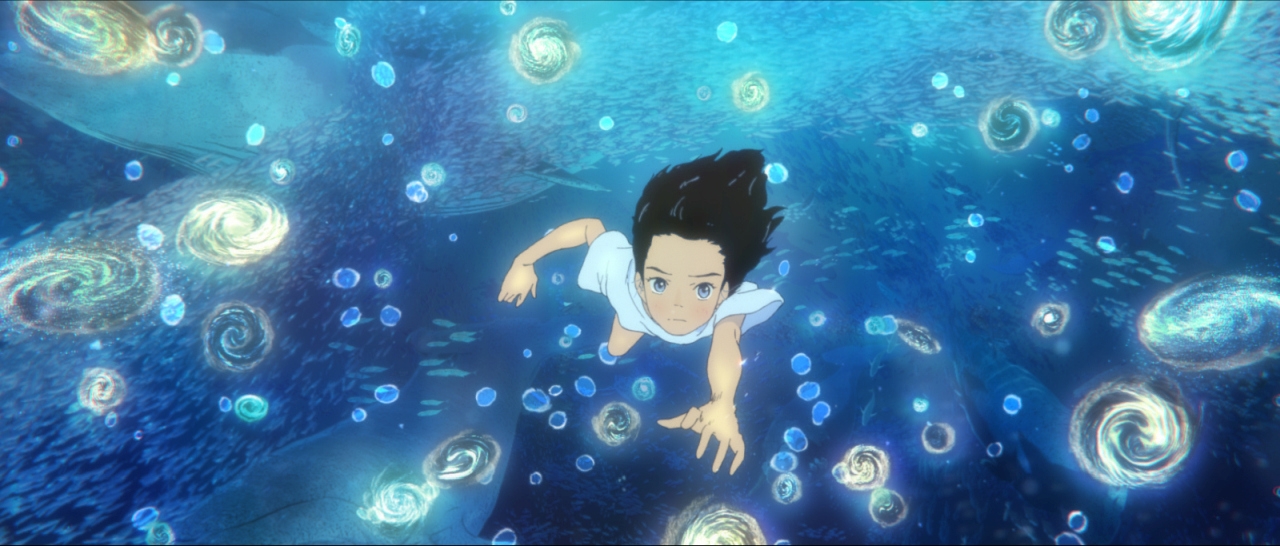
We see Ruka has little home life – her parents have split, and her mum’s coping badly. (There are many beer cans to take out.) So Ruka goes to her dad’s workplace, the local aquarium. There, she finds someone impossible – a merry, scampering boy who dives into the aquarium’s tanks and swims like a merboy through fish and turtles. He was found in the sea, in the company of dugongs, the gentle sea mammals which may have inspired the mermaid legend.
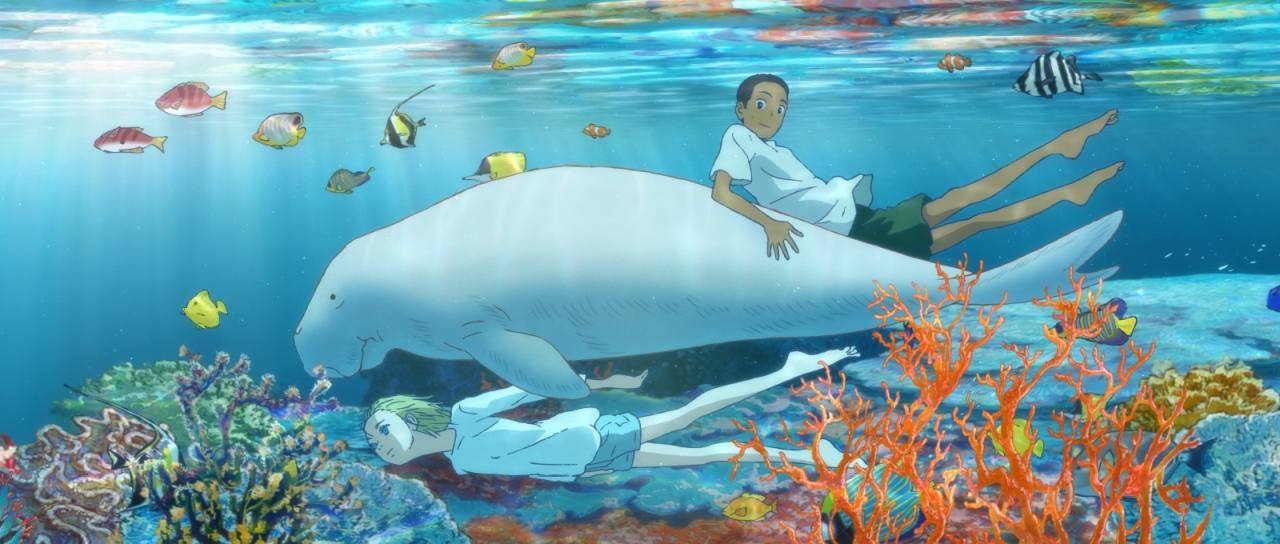
The boy, named Umi (Japanese for “sea”) is charming and spontaneous, like Ghibli’s Ponyo or Yuasa’s Lu (from Lu Over The Wall). But he has a frailer, older brother, Sora (“sky”), who might have emerged from the forest of Princess Mononoke. Ruka first sees him sitting on a rock on a beach at sunset. It’s an extraordinarily beautiful image, like a color plate in an old fairy tale book. Sora is less kind than Umi, with suggestions of danger and mystery, as if he knows the world’s secrets.
And maybe he does. A range of adults are monitoring the two boys, in connection with some huge event due to happen in the sea. (There are shades of Akira; remember those mysterious withered kids, always under army observation.) But Ruka’s still drawn to the boys. As someone who can’t make connections in her normal life, she’s fascinated by the world beyond humanity. As Ruka spends more time with her friends, could she change too? Fantasy allegories for puberty don’t always end well, even in fairy tales. A kiss under the stars by a radiant sea could spell doom for a curious girl.
Children was made by Studio 4°C, which is reflected in some shots showing off the animators’ handling of 3D space, like the studio’s 2006 film Tekkonkinkreet. Near the start, there’s a dazzling “dolly”-style shot, pulling away from a distraught Ruka running downhill, though her sensitive animation needs no embellishing. But Children also feels like Ghibli, without looking like Ghibli. Its character outlines feel more sharply inscribed; its summer light is brighter, its atmospherics more overt.
Yet it preserves Ghibli’s soul, which is surely thanks to Kenichi Kosaka, the Animation Director. Kosaka has copious Ghibli credits, animating on films including Princess Mononoke and Spirited Away and being the Animation Director on Princess Kaguya. Outside Ghibli, Kosaka was also a major collaborator with Satoshi Kon, with Animation Director credits on Millennium Actress and Tokyo Godfathers. He would re-team with Watanabe on Lady Nikuko.
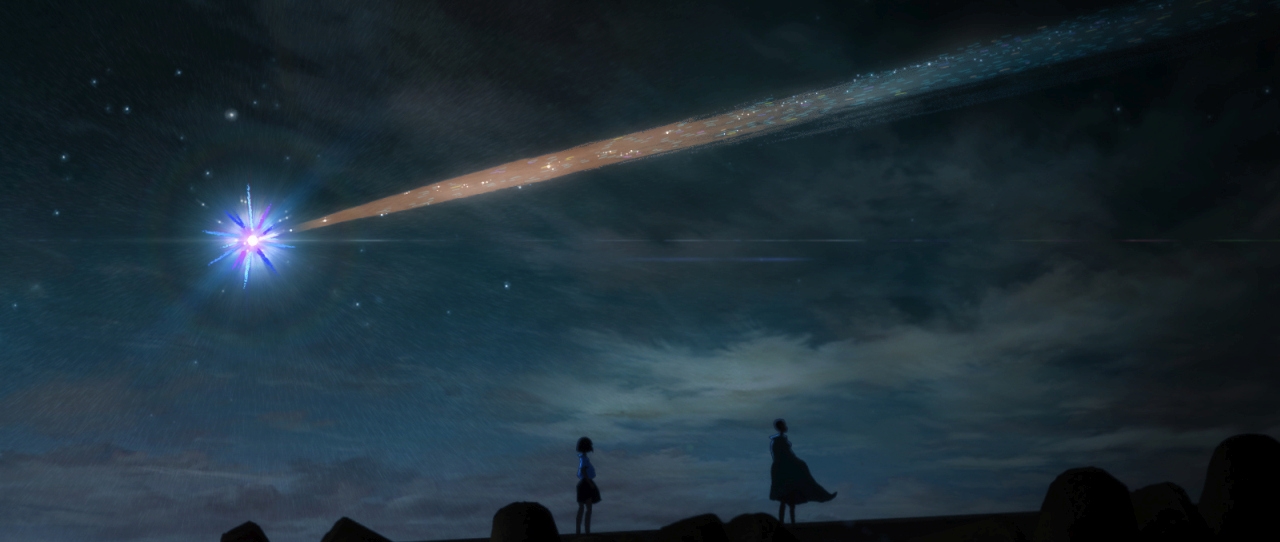
Now it’s time to discuss the Children of the Sea’s big issue, at least from the commercial point of view. I’ll minimize spoilers, though there’ll be some.
At almost exactly the film’s halfway point – just after the kids have had a lyrical night feast in the middle of nature – a character starts to speak, apropos of nothing, about Dark Matter and the memories of the universe. As switches go, it’s like moving from the first Ghost in the Shell film to its far less populist sequel, Innocence. There’s more mystical talk in that vein, along with what some viewers will feel is an unreasonable lack of clarity about what the heck is happening, as things start getting really trippy.
While the film’s visuals become even more beautiful, they no longer evoke Ghibli. Rather Children approaches the apocalyptic anime cinema trips – the final mind-blowing crescendos of Akira and End of Evangelion. Children doesn’t have their violence, but it does have Hisaishi’s orchestra working overtime, as new-born universes explode over the screen.
Frankly, Children probably makes more sense on screen than Akira. At best, it visualizes the ancient idea of “as above, so below” – that a bit of the universe can reflect and influence another bit on a vastly different scale. Portions of the climax make more sense if you ignore the dialogue and focus on Ruka’s vibrant journey, blurring inner and outer space, microcosms and the cosmos, struggle and acceptance. The struggle part, for instance, is shown through two figures frantically climbing over each other up a golden waterfall, all still resplendently animated, towards the source of creation. That’s far out.
And if you hate Children when it finishes, then consider this: did you accept such cosmic madness in Akira or Evangelion? Did you only resent seeing it here because you thought Children was like a Ghibli film? That seems a very limiting view of a medium which can produce a film as remarkable as Children of the Sea; divisive, but also quite wonderful.
Summer Time Rendering
And so on to Watanabe’s Summer Time Rendering. A 25-part serial, it was screened on Japanese TV from April to September 2022. However, unlike many anime TV series, Anglophone fans couldn’t stream it online as it aired in Japan. That’s because it was bought up by Disney, who acquired it and held it back until January 2023, when it was released on Hulu in America. (Viewers in Britain and other territories can find it on Disney+.)
It was a move unpopular with many fans, who coined the phrase “Disney jail” for such practices. It was argued that because Summer Time Rendering wasn’t streamed “live,” many anime fans would miss it, although fan pundits strove to promote it - understandably, as it’s a great show. However, Disney dropping the 10-hour series all in one go had at least one benefit. This is one of the most binge-able anime ever: non-stop cliffhanger action, an anime 24.
At the series starts, teen boy Shinpei travels to a small Japanese island, his former home, for his adopted sister’s funeral. Here he soon finds that the islanders are being replaced by supernatural doubles that are murderous brutes – this may well be the goriest animation that Disney has ever hosted. But Shinpei finds he has a “save” power. Whenever he gets killed, he finds himself at a slightly earlier point in the story, given another go.
The early episodes play like horror, with bloody shocks and one grand-scale atrocity that’s so apocalyptic that you wonder where the story can go after that. But the show isn’t interested in milking atmosphere or dread. There’s none of the slow-burn menace of the old Invasion of the Body Snatchers films, which defined the “doubles are replacing us!” story. Nor does the hero go mad as he loops round in time and sees horrors repeat in fresh permutations. This isn’t Perfect Blue or Re:Zero. (I wrote more about that vein of anime here.)
No, we’re having too much fun in Summer Time Rendering to be scared. We’re racing with our heroes around woods and deep caves, working out dazzling time-twisting strategies even while heads are pulped and limbs are lopped. Shinpei himself is the show’s weakness. He’s flatly heroic, not quirkily personable like other anime time-travelers (Okabe in Steins;Gate, Subaru in Re:Zero). He’s the anime staple, the “everyboy” surrounded by multiple girls.
And yet those girls’ support of Shinpei, with the expected attractions and embarrassments, is charming, fun and funny, stopping the show sinking into plot origami. The visuals are scrumptious, sweet sun-drenched scenery and skin-tones. The really big battles get saved for the second half, with bursts of frenzied fight animation as the series rises towards the cinematic.
Yet the series stands in marked contrast to Watanabe’s recent cinema. Though wildly different from each other, Children of the Sea and Fortune Favors Lady Nikuko are each highly individual visions. In contrast, Summer Time Rendering is an ultra-polished genre anime and entertainment rush. It’s a triumph, though it’s targeted full-on at anime fandom. The upfront fanservice (sexualized jokes) in the opening minutes will throw some viewers out instantly, though it’s far less frequent thereafter.
Don’t expect this to be a horror series, or full of fanservice. Rather this is an action-adventure marathon and it’s a blast. And yes, it has a definite ending.