Columnist Andrew Osmond enthuses about the musical comedy, now on Crunchyroll, and how not all anime musicals feature pop idols.
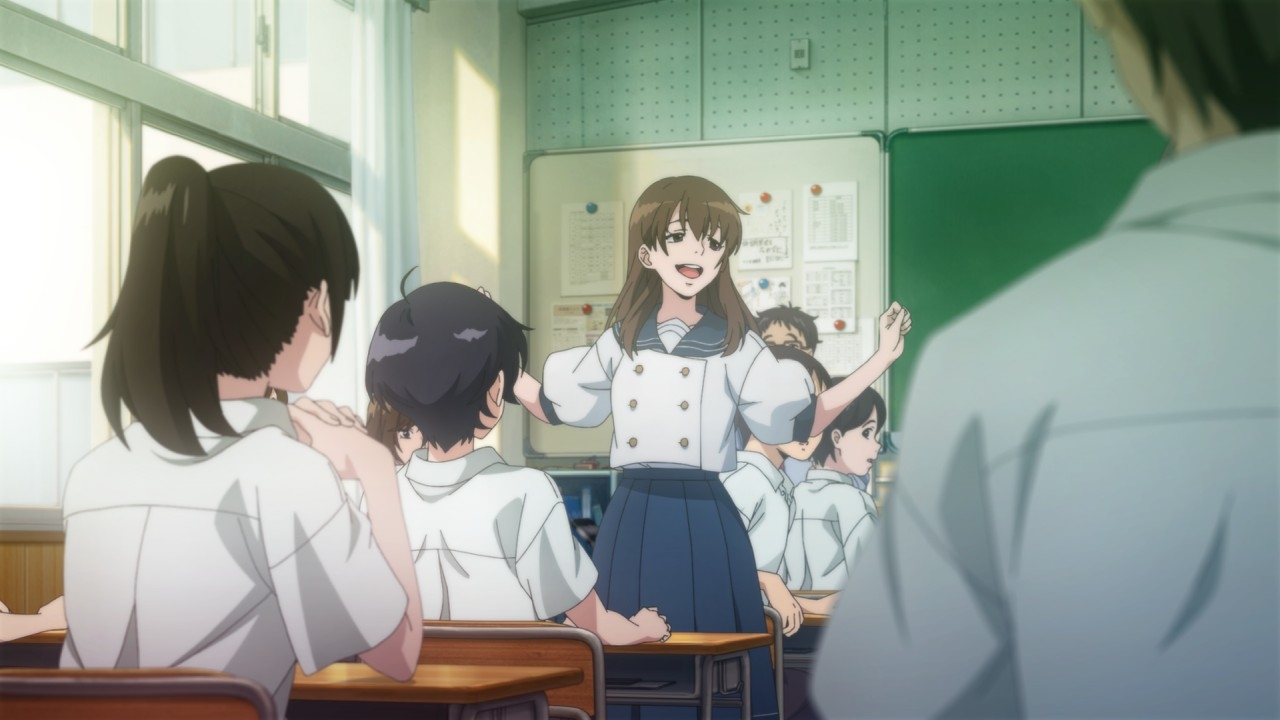
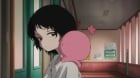
You may know Disney’s 2007 Enchanted, a mostly live-action comedy where one of the studio’s trademark princesses (Amy Adams) appears in New York and sweeps up the city in song numbers. Sing a Bit of Harmony is a funny, lovely film that’s framed as sci-fi, but it does the same thing, or at least it feels like the same thing. It’s anime (you can find it on Crunchyroll), so naturally the radiant singing stranger is a sailor-suited schoolgirl, and an android too. But she still has a thing for princesses, even forcing a shy “real” girl into a regal dress; this robot can push humans’ buttons.
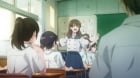
Released in 2021, the film’s set in the future, but it wisely uses a rural setting, though simple ‘bots tend the rice fields and drive the buses. Student Satomi is enduring more than living her schooldays. Her closest bond is with her single mum, a dedicated scientist working at the local robotics company. When the new girl, Shion, shows up in her class, Satomi realizes this is her mum’s project; she’s testing the android to see how it interacts with human kids. But Satomi can’t understand why Shion is fixated on her from first sight, obsessed with making her happy.
Sing a Bit of Harmony starts off entertaining and ends up a pure-hearted delight. One way in which it doesn’t feel like a ton of anime is that it features an android schoolgirl without a hint of prurience or objectification. The first half is a feel-good comedy that turns good feelings into comedy. Shion bursts into song numbers that play her selfless joy against the stupefied “what the heck?” expressions of her onlookers.
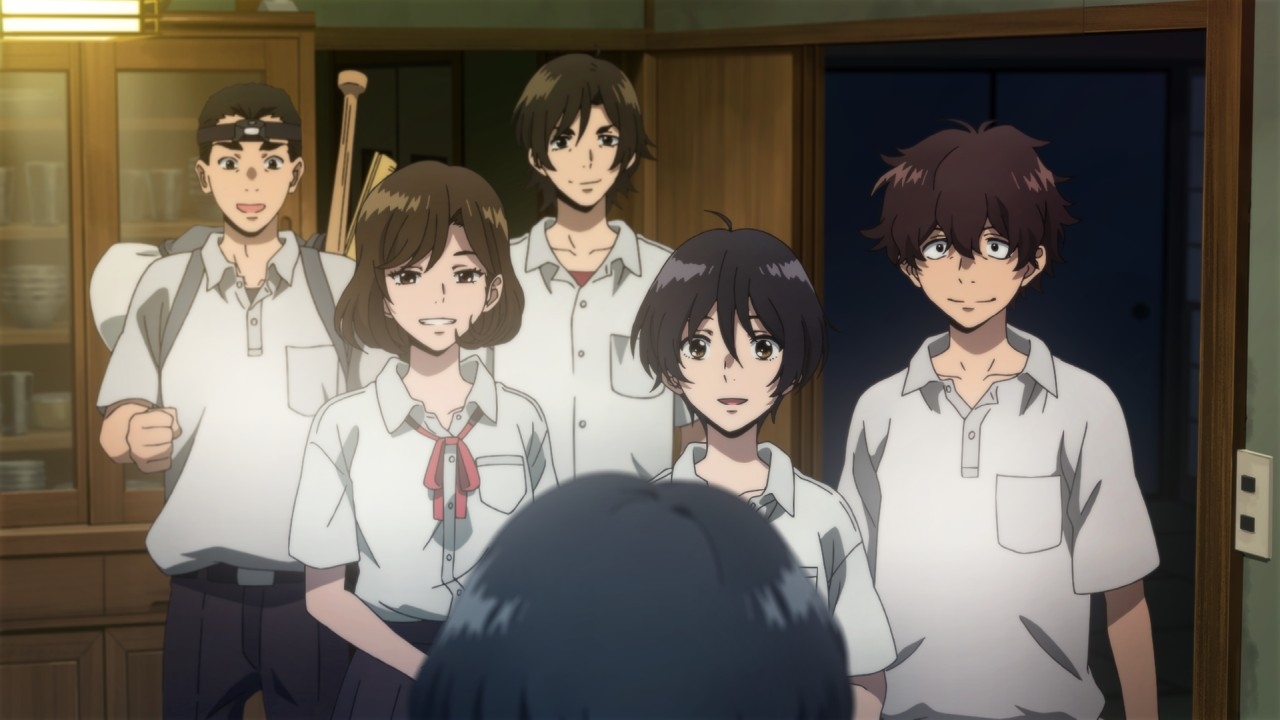
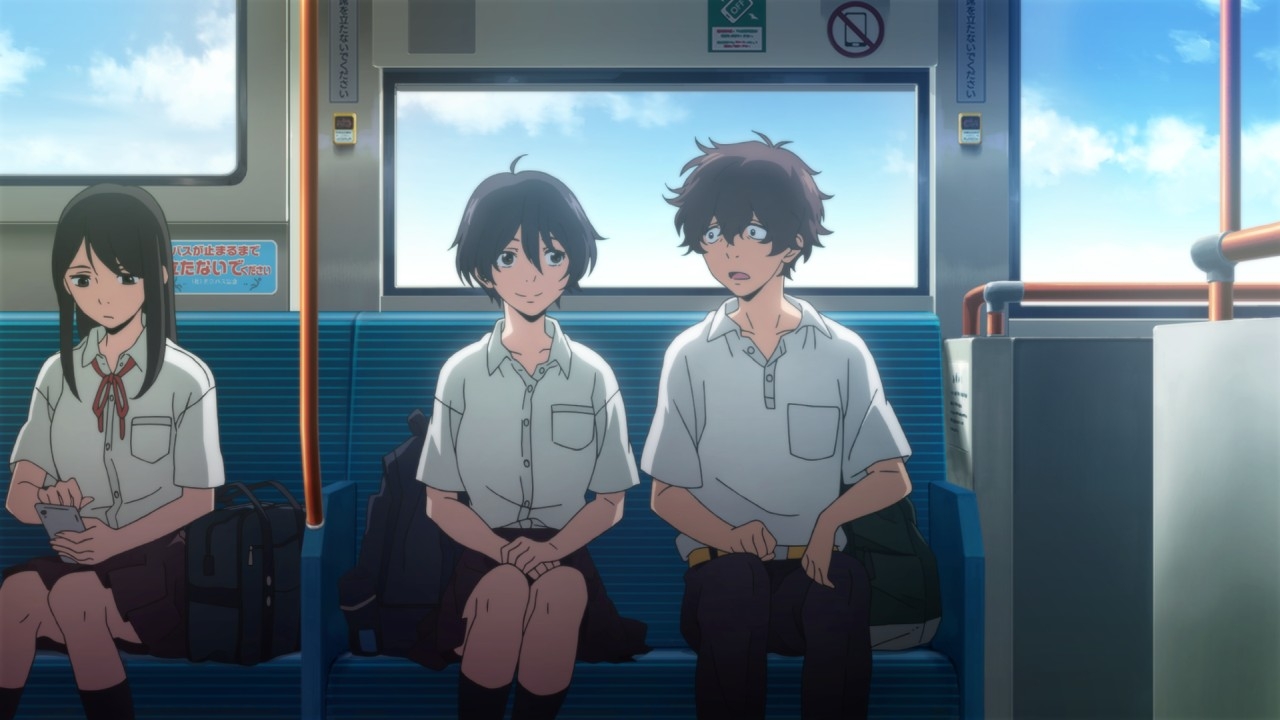
That’s like Enchanted, but the anime also flings Satomi together with a bunch of other students who share Shion’s secret. (Satomi fears that if the grown-ups realize Shion’s cover is blown, it’ll ruin her mum’s work.) The issues and awkwardness of the human kids recall some of the uncomfortable anime teen dramas written by Mari Okada (Anohana, Anthem of the Heart). But there’s less angst as Shion lets the kids hear a kinder soundtrack to their lives.
Teens in love
American cartoons are often about parenthood, including Pixar’s just-opened Elio. In Sing a Bit of Harmony, the subject is brought up in a way that’s obvious yet fascinatingly peripheral. The depth of Shion’s caring for Satomi is shown far more vividly than any of the scenes between Satomi and her actual mum. It’s hard to imagine an American version of the story not building up that contrast to define the film. But in Sing it’s incidental; the anime doesn’t foreground parenthood, but rather teens in love.
What makes the film outstanding is a story reveal in the last act, cunningly seeded through earlier scenes. It’s utterly lovely, an old love story idea given a science-fiction spin to sing again. It makes the film feel like a song when you watch it again, knowing what everything’s building towards.
Next to that, the film’s potential problems feel mostly irrelevant, like a laughably obvious villain who’s there simply to move things along. One boy character’s fried-egg eyes feel like a design fail at first, but later they suit him in a way that’s anything but mean. As for Shion’s songs, they’re not earworms or barnstormers to compete with “That’s How You Know” from Enchanted, or other classics from the Great Disney Songbook. But they’re still endearingly joyous, like a schoolgirl singing from the heart.
Shion is voiced and sung in Japanese by the actress-singer Tao Tsuchiya, who you can see in Netflix’s live-action fantasy thriller Alice in Borderland, which continues this September – she’s the heroine Usagi. By the way, if you want a Japanese live-action equivalent to Enchanted’s “That’s How You Know,” then look for the 2011 film Moteki, a romcom based on a manga, which has a fantasy park sequence involving the pop trio Perfume, as heard on American Dad! and Cars 2. As of this writing, Moteki’s musical sequence can be seen here.
Feeling elevated
Sing a Bit of Harmony’s director is Yasuhiro Yoshiura, who’d previously made the 2010 anime Time of Eve (available on Crunchyroll) about humans and androids meeting in a café. Yet Sing is closer to Yoshiura’s 2013 non-android, non-musical fantasy film Patema Inverted, which is also available on Crunchyroll.
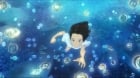
Both films use hilariously absurd situations to elevate teenage feelings. In Patema Inverted, the boy and the girl are upside-down relative to each other, so they must cling together with all their might and embarrassment, floating and bouncing like astronauts or trapeze artists. Shion in Sing is a fundamentally similar device, a preposterous force of nature, pouring music and song into a world of awkward silences.
Reality is raised to the level of emotion through upfront fantasy, rather than through the artifice of film. Indeed, one of Sing’s loveliest moments is a joke about such artifice. When Shion breaks into her first big song in a music room, we see her AI is activating the electronic instruments and speakers, meaning the music behind the song is diegetic; the characters on screen can hear it. One reason this is funny is because it’s such a redundant rationalization. It’s still utterly crazy that Shion is breaking into song, as it was with Amy Adams in Enchanted.
Yet those two characters are so different in conception. Enchanted’s heroine comes to “our” world from a cartoon world where everyone sings as a matter of course. American musicians, including Enchanted’s composer Alan Menken, have argued that animation lends itself to heightened reality. That’s why it feels less silly in animation when characters break spontaneously into song than it does in live-action. Enchanted is partly a comedy about (singing) animation and (non-singing) live-action and about crossing the gap between them.
But anime has never run on those rules. Kusanagi can’t break into song in Ghost in the Shell, nor Chihiro in Spirited Away. There are some “singing” anime – including an important fictional one in Sing a Bit of Harmony – but singing isn’t baked into the medium as it is in Hollywood cartoons. That Enchanted and Sing come from such different contexts, and yet they both work so similarly and well, is a cross-cultural wonder. It’s like when America’s cowboys and Japan’s samurai turned out to have so much in common.
A buried singing heritage
And yet there are still important music numbers in anime. Most obviously, of course, there’s the slew of anime in recent decades which are about singers, usually pop idols. It’s an area I touched on in a previous column, about the film Trapezium, where I acknowledged the prominence of idol anime franchises such as Love Live! and BanG Dream! As I said then, though, it’s not a field I’ve gone into deeply myself.
I’m more beguiled by semi-animated music videos such as the one below, which I’d rate as Japan’s answer to Peter Gabriel’s British-animated Sledgehammer. Called Traveling, it features the singer Hikaru Utada, familiar to players of Kingdom Hearts. Made in 2002, the video was created by Kazuaki Kiriya, who’d soon become her first husband. Readers may know him for such CG-heavy quasi-animated feature films as Casshern (2004) and Goemon (2009).
But songs were a strong part of anime in its early days, long before idols. For example, there’s the very first Japanese animated feature, Momotaro’s Divine Sea Warriors, released in the final days of the Pacific War in 1945. It’s a propaganda film, depicting the victories of the Japanese military, drawn as benign cartoon animals. In the scene below, the soldiers take time out to teach some island animals the alphabet in musical style.
Moving on 13 years, here’s a musical moment from Japan’s first color cartoon, Hakujaden in 1958.
The start of this trailer for 1968’s The Little Norse Prince (aka The Great Adventure of Horus, Prince of the Sun) contains shots from a glorious musical sequence – although the full sequence is longer, its spectacle evoking the village scenes in Disney’s Pinocchio. Unlike Disney, though, there’s a clear Marxist subtext – you could take the sequence as musical agitprop. It was the first film directed by Isao Takahata, future star of Studio Ghibli, who’d make Grave of the Fireflies and The Tale of the Princess Kaguya.
If such scenes seem way too old, then I’ll jump forward 27 years to the original Ghost in the Shell in 1995, directed by Mamoru Oshii. I said earlier that its heroine Kusanagi could never break into song. Yet the scene below is one of the most famous in anime, depicting Kusanagi’s existential crisis as a cyborg whose very body is mass-produced. The music was composed by Kenji Kawai, and the song was performed in Yamato, an ancient language of Japan.
After that, it would be remiss of me not to include another of anime’s most famous “musical” scenes from the turn of the century, from the fifth TV episode of Cowboy Bebop in 1998. It’s “Green Bird,” created by the iconic anime composer Yoko Kanno. The language of the song is Kanno’s own invention.
Moving forward to what even younger viewers might deem as modern anime, there are the blockbusters by Makoto Shinkai, and especially 2019’s Weathering With You, in which multiple key sequences play like music videos, scored by the pop group Radwimps. Those sequences don’t seem to be excerpted online, but this GKIDS trailer for Weathering, set to one of the main numbers, gives a good sense of what they feel like. The song is “Grand Escape,” for which Radwimps collaborated with the singer Toko Miura. Around the same time, Miura was also taking a lead role in the live-action Japanese film Drive My Car.
For many anime fans in the 2020s, the standout animated music performer was Uta, the center of the 2022 blockbuster One Piece Film: Red. Her signature song was “New Genesis,” though I found its animated presentation disappointing. Uta, I should say, is the film character; the “real” singer is the enigmatic Ado, who’s yet to reveal her face or much about herself. (I wrote her up here.) Her singing was set more impressively to animation in the opening titles for the second TV season of Spy x Family, a sequence helmed by the feted director Masaaki Yuasa.
Yuasa also directed the 2021 feature film Inu-Oh, about two singers in medieval Japan, who seem remarkably similar to certain pop stars of the last century. Here’s a clip: the (real) singer is Avu-chan of the bands Queen Bee and Gokumonto Ikka.
My last pick – perhaps not a surprising one – is another 2021 film, Mamoru Hosoda’s Belle. It’s highly unusual in openly referencing Disney, and specifically the studio’s 1992 Beauty and the Beast (I discuss the homage here). It’s about a pop starlet in cyberspace, although her alter-ego is an extremely shy “real” schoolgirl. The video below is from Belle’s English dub; the singer is Kylie McNeill, and the music’s by the band Millennium Parade.
Still, I should end with the admission that none of the anime I’ve talked about here are as well-known as the biggest Hollywood animated imports, which typically out-gross them many times over. And I’ve noted before in this column that for many Japanese people, “anime” means animation from any country. So, if you ask many Japanese millennials what their favorite “anime song” is, then be prepared for an answer like the one below. The Japanese singer is Takako Matsu.