Amid alarm over the latest Pixar film’s weak box-office opening this week, and fears about films with ‘original’ stories vs. sequels, Andrew Osmond looks at how IPs co-exist with originality in anime movies.
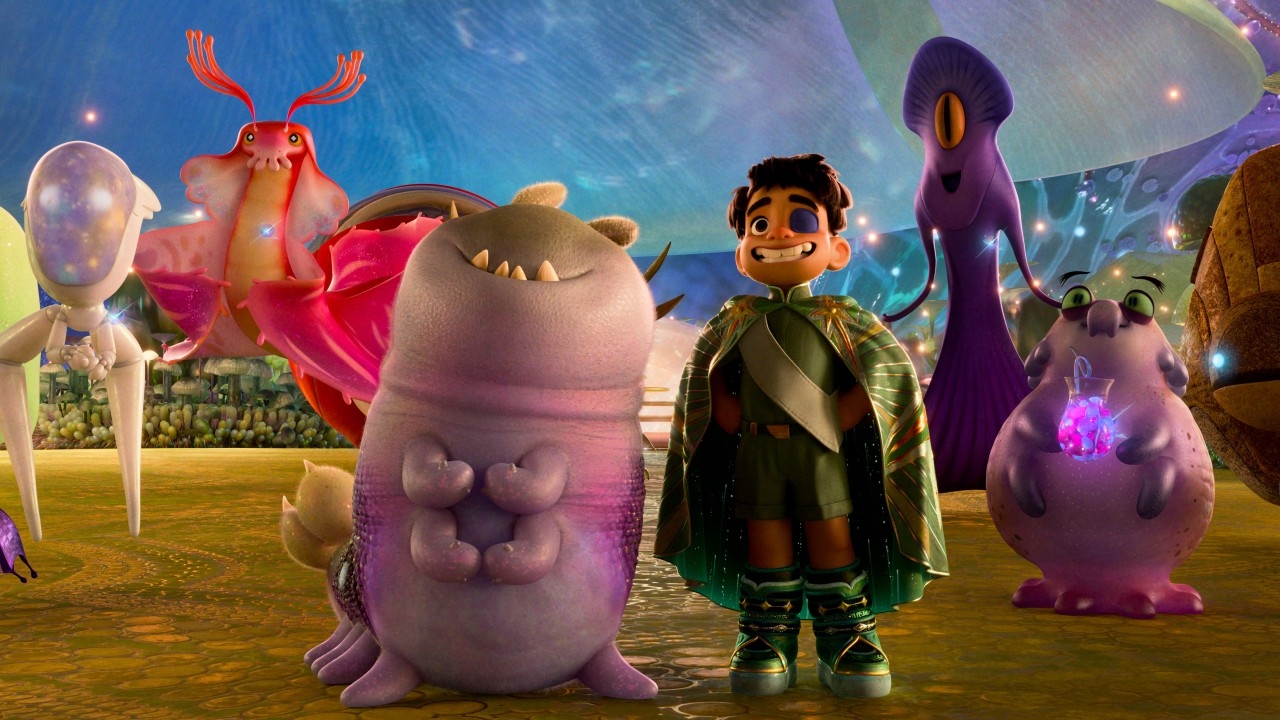
As sometimes happens, my anime article of the week is prompted by a non-anime news story. This time, it’s the storm over Pixar’s Elio and its box-office faceplant, or as one Simpsons character would say, its Worst Pixar Opening Ever. Personally, I liked Elio, though I thought its space adventure narrative would always be a difficult sell.
Incidentally, Elio doesn’t open in Japan until August 1, with a title that reportedly translates to “Star-Linking Elio.” Naomi Watanabe, a famous Japanese comedian, will have the distinction of voicing an Elio character – Ambassador Auva – in both English and Japanese versions of the film. Meanwhile, Ambassador Questa’s Japanese voice will be provided by Miyuki Sawashiro, a prominent anime actress, who’s Fujiko’s current voice in the Lupin the Third franchise.
For how Elio is being promoted in Japan, see below. As with other Hollywood animation, the Japanese marketers prefer highlighting the drama over its comedy.
As of writing, there are claims that Elio suffered in development because it was forced to be conservative in areas such as gender… which I think ignores a character’s surprise transformation at the end of the actual film. For the purposes of this article, though, I’m focusing on one of the other arguments provoked by Elio’s box-office.
That’s whether it shows the irreversible decline of “original” Hollywood animated features in the face of blockbuster sequels and spinoffs, motored by established IPs. You need only contrast Elio’s dismal numbers with those for Pixar’s Inside Out 2 this time last year, to say nothing of the live-action Lilo & Stitch and How to Train Your Dragon in recent weeks. (Sequels to both are in development.)
Movie pundits have also cited other “original” animated underperformers in recent years, such as Illumination’s Migration and DreamWorks’ Ruby Gillman, Teenage Kraken. Of course, there are counter-cases – DreamWorks’ The Wild Robot was a modest hit last year, by Lilo & Stitch creator Chris Sanders. Then there are indie heroes such as Latvia’s Oscar champion Flow – see its director Gints Zilbalodis discuss Flow’s debts to anime in the above video. Such films cost far less than the Hollywood crowd, but they repay themselves many more times over.
In any case, it seems worth pondering the balance between “original” and “spinoff” films in anime.
When creators are franchises!
In Hollywood, companies prize spinoffs from cash-cow brands. The market value of a product – a film, book, whatever – rises immensely if it has Avengers or Star Trek or Shrek stamped on it. The principle often holds in Japan too. Look at Naruto or Evangelion.
Yet in anime and manga, there are more creators whose names are brands to rival franchises. In effect, these creators are franchises. The two blockbuster directors in cinema anime are Hayao Miyazaki and Makoto Shinkai, neither of whom seems interested in sequels or spinning off their works. If anyone hasn’t noticed, there’s no Spirited Away 2 or Your Name 2, though the average fan could contrive pretexts for both in minutes. Those films’ non-existence is admirable, I think, and one of anime’s more appealing features.
Miyazaki actually made an anime sequel to his best film, My Neighbor Totoro. However, it wasn’t a feature, and it wasn’t for general release. As of this writing, the 14-minute Totoro film Mei and the Baby Catbus can only be seen in two Japanese venues, the Ghibli Museum in Tokyo and the Ghibli Park outside Nagoya. It’s not even available at those places all the time; it rotates with nine other similarly exclusive short films, nearly all by Miyazaki. The video above shows extracts from three of those films, though not Mei and the Baby Catbus.
It’s also notable that both Miyazaki and Shinkai created greatly expanded versions of particular animated works of theirs. But those expansions were not in animation. On Shinkai’s side, he wrote a prose novel expanding his excellent 2013 film Garden of Words, adding many more perspectives and developing characters who were barely on screen, far beyond a conventional novelization. I reviewed the book here. Was any of this extra material animated? No, it wasn’t.
As for Miyazaki, his 1984 film Nausicaa of the Valley of Wind was based on a far more intricate comic strip that he wrote and painstakingly drew. He carried it on for 12 years after finishing the film, taking its story far further, with enough new ideas for multiple films. But did he continue Nausicaa in animation? Again, no; not another cel in 40 years.
Instead, Japanese audiences have accepted Miyazaki’s and Shinkai’s animated films as “series” where the creator is the continuing element, while the story and characters change each time. The same goes for numerous other anime directors who’ve not reached the same box-office heights but still have critical acclaim and strong fandoms. Of course there’s the late Isao Takahata, Miyazaki’s mentor-colleague-rival, who directed The Tale of the Princess Kaguya above. Then there are…
Well, many fans wouldn’t even need me to say their names. There’s the director who likes building massive cities, then smashing them down or blowing them up. There’s the director who lyrically shows teens’ self-hating guilt or wordless longing. There’s the director who likes philosophizing cyborgs and basset hounds. There’s the director, who tragically departed far too soon, who loved dreams and delusions. Another director shows families and furries, and then there’s the director whose worlds and characters look like taffy: bright and stretchy.
If you need the names filled in, they’re Katsuhiro Otomo (Akira), Naoko Yamada (A Silent Voice), Mamoru Oshii (Ghost in the Shell), the late Satoshi Kon (Perfect Blue), Mamoru Hosoda (The Wolf Children) and Masaaki Yuasa (The Night is Short, Walk on Girl). Other directors don’t have that level of recognition yet, but some fans already know them for their outstanding work, and they could break out soon. I’ve covered some in my past columns: Ayumu Watanabe (Children of the Sea), Yasuhiro Yoshiura (Sing a Bit of Harmony) and Sunao Katabuchi (In This Corner of the World). The trailer below is for Katabuchi’s upcoming film, The Mourning Children.
Were there ever Hollywood animation directors with that kind of name clout? Perhaps the strongest candidate was Brad Bird at the time of the first Incredibles, when the mainstream had realized how good his Iron Giant was too. But then Bird moved into live-action to make a well-received franchise film – the fourth Mission Impossible movie, Ghost Protocol – and then his deeply personal, commercially calamitous Tomorrowland in 2015.
Most obviously, Pixar itself had huge name clout as a studio, through its halcyon years in the ‘90s and ‘noughties. That was when audiences would go to pics with ideas as eccentric as Ratatouille, Wall-E and Up. Like many fans, I think that Pixar’s still capable of films that good. But there’s no denying the studio currently looks reliant on its greatest IPs, prepping sequels to Toy Story, Incredibles and Coco. And who’d bet against Inside Out 3 being announced in the near future?
The rest of the picture
So far, I’ve painted the grass far greener on the anime side, describing a bevy of director-driven features, including some of the highest-earners of all. But of course, there are also a huge number of IP-driven anime films, where the director’s name typically counts for nothing next to the title and the characters.
Often these are films recycled from TV animation, or previewing TV shows just about to come out. AWN’s Victoria Davis focused recently on one such specimen, the new Dan Da Dan “film” in June. Then there are the spinoffs which use new animation but are still embedded in ongoing IPs, and some of those IPs have run forever.
This April saw the 28th Case Closed (aka Detective Conan) film in cinemas, One-eyed Flashback, trailer above. March had seen the 44th cinema cartoon featuring the children’s character Doraemon. Crayon shin-chan’s 33rd film will come out this August, followed in September by the 22nd film based on the children’s “magic girl” franchise Pretty Cure (and that’s not even counting the crossover film series, Pretty Cure All Stars).
This is the truly strange thing about cinema anime. It supports director-driven films, some of which could reasonably be called auteur works. At the same time, it also supports franchises which are so ridiculously long that they make, say, Illumination’s Minions (with or without Gru) look like IP lightweights.
And in the last few years, the IP-driven anime film has been rising fast in Japan. Specifically, these are films based on strips in the manga magazine Shonen Jump. They ramped up during the Covid pandemic with the astonishing success of 2020’s Demon Slayer: Mugen Train. Since then, there’s been the huge box-office of Jujutsu Kaisen 0 (2021), followed by One Piece Film: Red and The First Slam Dunk, both in 2022. Case Closed: The Million Dollar Pentagram was a smash last year, and its successor One-eyed Flashback is now climbing both the Japanese and Chinese box-offices.
Of those films, though, it’s worth noting that The First Slam Dunk (trailer above) is not a conventional “franchise” product at all. Written and directed by Takehiko Inoue, the famed creator of the original Slam Dunk manga, his film is a bold reinvention. Inoue puts one of the supporting characters, and his tragic family history, at the film’s center, which completely redefines what the story is about. In effect it’s a brand-new story, which you can follow perfectly well if you’ve never encountered Slam Dunk before.
To invoke a Pixar analogy, The First Slam Dunk is like a theoretical Inside Out 3 which followed the everyday life and tribulations of the girl Riley, with her “emotions” reduced to support acts and the focus on Riley in the real world. Of course, such a film would never get to the pitch stage. Perhaps the only Hollywood franchise sequel that ever went so far off-piste was last year’s part-animated Joker: Folie à Deux and we know how that fared commercially.
The First Slam Dunk, on the other hand, was an international smash, especially in Asian countries. And in seeming contradiction of what I said earlier, there is “talk” of a sequel (which some viewers would think was implied by the “First” in the title). And yet, it’s not the talk you’d expect in Hollywood.
For one thing, there seems little chance of a sequel being made if Takehiko Inoue doesn’t make it personally. For another – well, I’ll hand over to Inoue’s own comments last August, quoted on Anime News Network.
“If I said there will be [a sequel] or said there won’t be one, wouldn’t that statement tie me down? Like if I say there will be one, and there isn’t, that’d be bad. And if I said there won’t be one, then even if I feel like drawing one, I won’t be able to. So, I'm not going to say anything right now.”
Still, a Second Slam Dunk seems 100 times more likely than Elio 2.