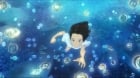
Irish animation studio Turnip & Duck’s new 2D series on CBeebies about a 7-year-old visually-impaired girl and her doggy best friend turns on its head the old adage that ‘actions and visuals speak louder than words.’
Typically, in animation, creators are encouraged to live by the “show, don’t tell” rule, where actions and visuals speak louder than what’s being said. But in Maddie + Triggs, the latest award-winning 2D TV series from Irish animation studio Turnip & Duck and CBeebies, that time-tested, long-abided rule has been turned on its head.
“We would ask our writers, ‘Write the story you’d normally write, but then close your eyes and see if it still works,’” shares Aidan O'Donovan, co-founder with Colm Tobin of Turnip & Duck, known for series like Atom Town, Brain Freeze and Critters TV. “We try to embed a lot into the dialogue and the music. In each episode there’s a sound focus, a musical style based on that sound, and then a story that pulls it all together.”
Available to watch on YouTube, Maddie + Triggs follows a seven-year-old girl, Maddie, who just so happens to have a visual impairment, and her doggy best friend Triggs, as they find music and adventure in the sounds of the everyday by really listening to the world around them.
Check out the trailer:
Bonnie O’Meara is the young star of the show who shares a visual impairment with her character Maddie. The series, narrated by Siobhán McSweeney (Derry Girls, The Great Pottery Throw Down), has launched 26 episodes in Ireland on RTÉjr and in the UK on BBC’s CBeebies. 26 more episodes are slated to release this year.
Before eventually appearing on YouTube, with animation from Bristol’s Sun & Moon studios, the show actually began as a podcast, which can also be listened to on RTÉjr Radio and Spotify.
“This all started when we were delivering one of our previous shows to the national broadcaster here, Raidió Teilifís Éireann (RTÉ),” shares Tobin, who also serves as Managing Director at Turnip & Duck. “As part of our delivery, we had to provide an audio description. That wasn't something we had done before and, for production reasons, I was talking to the audio description guy in RTÉ about delivery and technical stuff and had a really good conversation with him. I learned that he had become blind later in life and he commented that our show Brain Freeze was really accessible because he could follow along from the audio perspective.”
He adds, “It was a really interesting conversation, but we also felt ashamed of the fact that we never considered that audience in any way before. We were totally ignorant about what their needs might be. So, we were like, ‘What if we were to design a show from the ground up, not necessarily for that audience exclusively, but with that audience in mind?’”
The show was always intended to be an animated series, but O’Donovan and Tobin both note that establishing the series in audio-only format first helped the show and the team gain traction in their goals: to create an animated series viewers wouldn’t have to see to enjoy.
“I had studied jazz performance and Colm had studied music technology in school,” notes O’Donovan, currently serving as Turnip & Duck’s Creative Director. “So, we had this duo, a girl and her dog, and we had this idea where they would find music in the sounds of every day. At the time, my daughter was only about a year old, and we were in the park one day and she was crunching leaves against her ears. At that point for a kid, everything is brand new. Everything is full of wonder. And there are sounds in the everyday things that should be celebrated.”
He continues, “So, for the first episode, we started with a crunchy leaf. Then we thought, ‘Where do we go from there?’ We hadn’t a clue. But we liked the ‘Crunch, munch, crunch,’ kind of word-play and I was like, ‘That feels like a Tom Waits kind of song.’ Then we thought, ‘Who might sing that in their world?’ Maybe they discover a little caterpillar, and they’ve accidentally endangered his house. That's how we discovered the world, with sound and music first.”
And later, when it came to creating the animated series, music and sound were still at the top of the pipeline.
“Usually in animation, music comes at the end, and musicians and writers rarely ever meet,” says O’Donovan. “But our lyricist Dena Diamond worked at the start of the pipeline with our writers and even contributed one of the scripts.”
Diamond, like a number of Maddie + Triggs production team members, is visually impaired, and first connected with O’Donovan and Tobin through the charity Vision Ireland.
“Because being visually impaired wasn't my or Aidan’s lived experience, the first thing we did was reach out to some organizations so we could talk with people who did have a personal connection to the topic,” shared Tobin. “Vision Ireland advocates for blind and vision-impaired people across Ireland. We got in touch and told them we had this idea for a show, and they were really supportive and encouraging. That led to us finding our cast, which Vision Ireland also assisted with, and that’s how we found Bonnie and Dena. Bonnie also just happened to live up the road from Aidan. It was a weird coincidence, but one of the first examples of the universe telling us to push the show forward.”
In Tobin’s words, the production was “a tiny team with a tiny budget,” but the creators, and their DEI lead Shelley Boden, were adamant that they needed visually impaired representation throughout production of the show, especially in the writers’ room.
With funding through Screen Ireland, Ireland's state development agency for the Irish film, Tobin and O’Donovan created a paid writer’s shadow scheme, or workship, that ran for seven weeks. The duo put out a call to anyone who was registered blind or vision impaired. The seven-week course was an introduction to writing for animation and, of the 10 writers who participated in creating spec scripts for Maddie + Triggs, four were commissioned with full scripts on the series. Audio Description lead in RTÉ, Óran O'Neill, was also a student of the Listen Hear animation writing shadow scheme and was one of the writers whose script made it on the show.
“We had to roll up our sleeves and do this right,” says O’Donovan. “It does take extra resources but, even at a time where this kind of stuff, DEI stuff, is being cut left, right and center in lots of parts of the world, it’s worth standing up for so we can do these shows properly.”
Vision Ireland also facilitated meetings between Tobin, O’Donovan and a number of kids who could speak to what it was like being blind or visually impaired consumers of cartoons.
“When we were ready to do visual development for the series, the first step was meeting with kids who were visually impaired to ask them what shows they liked,” says O’Donovan. “Many were into the same cartoons kids without sight issues were into, but the difference was that busier cartoons, faster cartoons, cartoons with more detail that we might consider having higher production value, could get very exhausting for vision impaired kids. Of course, every kid in this community is different and there’s no one solution, but what we took away from talking with this group of kids was that less is more. They liked shows with cleaner backgrounds and simpler colors.”
There is a contrast to the show. While the audio is rich and textured, the visuals are more on the minimalist side, leaning toward geometric shapes as visual cues for what’s taking place on screen.
“I mean, it’s one of the principles of a good design anyway, doing a silhouette test, so that, if you kill the color and the details, you still know which character is which,” notes O’Donovan. “But we also developed a color-coded approach to the characters. If a kid has blurred vision, they’re not getting much detail but they’re still getting some. So, Maddie is pink, Triggs is yellow, Granny is teal, and so on. The tonal variations express the characterizations. That’s a big part of what led to the aesthetics of the show being what they are.”
And since the show wouldn’t feature constant action with fast pacing, Maddie + Triggs characters have an outer rim on their design that is constantly in motion, giving the sense of movement, even when a character is standing still.
“That keep-alive effect on the character design was nice from a production point of view,” says O’Donovan. “The rules to these visuals are simple but it’s not easy. There’s a lot of precision that goes into the design.”
And a lot of training. Turnip & Duck as well as Sun & Moon worked with Angel Eyes – a charity based in Northern Ireland that provides guidance to the support networks of children diagnosed with a sight impairment – to go through training with an Oculus Rift called EmpathEyes, which simulates a range of vision impairments. It was all in an effort to help the animation teams gain a deeper understanding of what the target audience would be experiencing while watching the show.
Still, Tobin and O’Donovan didn’t want to get too heavy-handed with the underlying topics of the series. At the end of the day, this is not a show about a girl with a disability. This is a fun series that kids of all visual abilities can enjoy.
“We’ve always come at projects from a comedy point of view and Maddie + Triggs is the same,” says Tobin. “And whatever storytelling method best serves the mission of each project has been the key to the inclusivity of Turnip and Duck’s shows and what we're about as a studio.”
O’Donovan adds, “We’ve been treading carefully because we don’t want to launch straight into things like eye check-up episodes. We want to discover the world and the characters a bit more. But, as time goes on, hopefully this show does help kids to understand disability and difference more in their world.”

Victoria Davis is a full-time, freelance journalist and part-time Otaku with an affinity for all things anime. She's reported on numerous stories from activist news to entertainment. Find more about her work at victoriadavisdepiction.com.