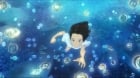
Dete Meserve and Michael Rabb talk about their new 2D preschool series, based on the picture book by Antoinette Portis, which follows Riley, whose vivid, ever-changing imagination takes her to fun, fantastic places with just a single, simple box; premieres June 13 on Apple TV+.
When it came to adapting Antoinette Portis’ award winning children’s book Not a Box, where a small rabbit creates big stories with only a box and her imagination, Ready Jet Go!’s Dete Meserve received a pitch from, in her words, “seemingly every great writer on the planet.” But, despite the impressive slate of ideas, none were getting the greenlight.
“I heard some really imaginative, creative pitches,” admits Meserve, executive producer of the Apple TV+ 2D animated series, premiering today, June 13. “One person came in and sang half his pitch. But what people were lost in is that they would think, ‘Oh, the box is like therapy. The kid doesn't like to eat vegetables, so now they can imagine a world where there are no vegetables.’ They would create a problem in real life that is solved in the box or with the box where it becomes a castle to hide behind or something like that. It felt like the wrong approach. I didn't want to go that route. Then, Mike walked in.”
Michael Rabb, who had written for other children’s TV programs such as Doc McStuffins and Daniel Tiger’s Neighborhood, heard pitches for Not a Box weren’t getting through and felt compelled to attempt a pitch of his own.
“I thought, ‘I better come up with something really different if I'm going to have a chance,’” shares Rabb. “So, I kept the book with me for two or three weeks. I took it everywhere. I kept it with me during the day. I took it on vacation. I kept it next to my bed in case I had a dream about it. When I went to visit my family in Las Vegas, I was walking with my niece, who was six at the time, and she said, ‘Uncle Mike, I want to tell you a story.’ After 45 minutes, I was amazed by how, at six years old, she was making up a story on the fly, making up characters, making up problems, coming up with solutions, changing her mind. And I thought, ‘That's the show, the way kids tell stories. They just make them up as they go.’”
In the series, produced by Meserve’s Silver Creek Falls Entertainment, Riley, a white bunny rabbit voiced by Isabel Birch, tells stories with a box – which is not a box, lest we forget – and her imagination, which changes course frequently. As Riley’s stories shift, the animation, produced by Passion Pictures, shifts with it and blobs of color morph from one idea into whatever Riley desires next.
Check out the trailer:
“Riley comes up with things on the fly and you’ll see it in the show,” says Rabb. “She wants to fly in a red rocket, but then, ‘Nah, I really want a green rocket.’ Poof. It'll change on screen.”
Meserve adds, “I had a lot of discussions early on with Antoinette and I asked her, ‘What are essential things you want to make sure come through from this book?’ And she said that kids already know how to imagine. They don't need to be told to imagine, they need to be empowered to do it, to engage in it, and to be told that this is a wonderful gift that we all have that no one can take away from us. That was a central part of what the series was about.”
Rabb and Meserve call Not a Box “play on the go” as not a single episode includes cut-away shots. They all cater to whatever wild twists and turns Riley can cook up in her mind, like a rabbit robot, polka dot trees, a cloud unicorn or a comet with handlebars and a tail.
“There are no time cuts, so we don't have any of the whiplash of it suddenly being tomorrow or six days from now,” says Meserve. “It all happens in that 11 minutes. You're never going to see us cut away from Riley's point of view. I think that is hugely grounding for kids. A lot of TV jumps from scene to scene and it can be very difficult for kids to figure out where they are.”
But the other part of the secret sauce in this series is that kids won’t be able to guess where the adventure is headed.
“Riley's imagination is going to take you to places you're not thinking about,” says Meserve. “Her stories are not typical castle stories or boat stories or comet stories. Every moment offers the opportunity for a surprise.”
Things get weird and Riley’s mind changes. But it’s all part of being a kid with beautiful, unbridled ideas.
“It was challenging to bring writers into my brain,” shares Rabb. “This show is very different from any other show I've ever worked on. It's not traditional in any sense of the word. And play-on-the-go is challenging for writers who have been working in Kids’ TV, which can sometimes be a little formulaic. I had to say, ‘Forget about all that. Start fresh and think like a little kid.’ That was the biggest challenge, but we overcame it and created some absolutely beautiful episodes.”
Of course, another ingredient in making such a captivating kids’ series is hiring the right production company. According to Meserve, that was also a tedious selection process.
“I think there were over a dozen animation studios that submitted ideas and some of them submitted multiple ideas,” recalls Meserve. “The work that jumped out to both me and Mike was by Siri Melchior. It felt like we were looking at a child's drawings but with a little bit of the adult kind of keeping things in order. And it had this tactile feel, and shapes were not what you would expect them to be. There was this unexpected feel in her approach. And it kind of leapt off the page in terms of the color palette she chose.”
Rabb adds, “Siri’s designs looked like the most beautiful picture book come to life. In a lot of the episodes, you'll see things that look handmade and cut out and things that definitely could have been put together by a child.”
Once Melchior was brought onto the team, she put her artists through a design boot camp, teaching everyone how to work with materials like cotton balls, stamps, paints, cardboard and more to help them get in the right mindset to create the animation which would be used on the show.
“Though ultimately the show was going to be made largely in the computer, this way the artists had a sense of what that animation should feel like,” notes Meserve. “We got a small taste of that training when Siri came here, and she made us cut out a bunny rabbit hat and made us get in touch with our inner child and the whimsical nature of the design work.”
Music for the series, written and produced by Gabby’s Dollhouse’s Courtney Lofty and Ryan Lofty, is also meant to sound like something a child could compose.
“I really wanted all the music to be created by toys or sounds that a kid would recognize and say, ‘I can make that,’” says Rabb. “We also have created hundreds of characters because Riley needs them. When she has to dig to the center of the earth, who better to help than an octopus who can hold eight shovels? That's part of the secret sauce too. In every episode you're going to meet a brand-new character who you're going to fall in love with.”
And every episode takes place in a new setting. Meserve notes that the people at Apple have been very open-minded, imaginative partners about the ambitions of the show and helped create a space where the writers and artists could open up their minds to dream and be children again.
“We were getting to fully be kids again, immersed in our own imaginations, and it was some of the happiest times,” says Meserve. “Imagination and creativity are obviously part of a creator's life, but also anyone's life. With astronomers, for example, the idea they came up with to land the Mars rover took somebody saying, ‘Well, what about balloons?’ Creativity is such a universal theme, and I hope this show makes every family and child proud of their imagination.”

Victoria Davis is a full-time, freelance journalist and part-time Otaku with an affinity for all things anime. She's reported on numerous stories from activist news to entertainment. Find more about her work at victoriadavisdepiction.com.