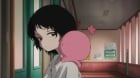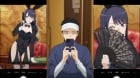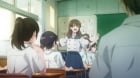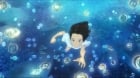
Released by GKIDS, the first 3 Season 2 episodes of Science SARU’s hit series, coming to U.S. theaters June 6 ahead of its full season release July 3 on Crunchyroll and Netflix, are filled with heartfelt moments alongside the cringy, lewd, sinister, and horrific, all richly, stylistically animated and colored to maximize its mesmerizing storytelling.
In a show like Dan Da Dan, filled with dong-gobbling grannies, perverted aliens and mannequins in love, it can be a bit of a shock when things get, dare we say, sincere.
For every cringy comment or lewd joke, there are just as many heartfelt, tender and completely wholesome moments between not only the main characters, but also between them and the supernatural beings they seek to eliminate. Episode 7 has become one of the first season’s more renowned stories, diving into the traumatic past of a woman who, after her child is kidnapped and murdered, becomes an Acrobatic Silky yokai who stalks a living child in hopes of becoming her new mother. It’s twisted, like most of Dan Da Dan, but it’s heartbreaking and proved the show a truly complex work of art.
And in the newest season, Dan Da Dan: Evil Eye, released by GKIDS and now playing its first three episodes in U.S. theaters, there are plenty more tears to shed amidst the screams and laughter.
“That's the thing I love about being in this show, the wide range that we're given to express and, as an actor, it always keeps things interesting,” notes Abby Trott, the English voice of Momo Ayase, the anime’s leading female protagonist who seeks to help the timid and alien-obsessed Ken 'Okarun' Takakura embrace his supernatural powers while both gifted teenagers fight yokai and aliens. “In the case of Episode 7, I’d read the manga but, when I was watching the animation leading up to the Acro Silky’s demise, it really ripped a hole in my heart. I was devastated. And that particular moment plays off of my own existential fears. So, when Momo is asking, ‘What happens to her now?’ I was genuinely in that place. That hit hard for me.”
The complete new season, slated to be released July 3 by GKIDS on Netflix and Crunchyroll, picks up where the first season left off with Momo and Okarun investigating the home of Momo’s childhood friend Jin 'Jiji' Enjoji, who claims the place is haunted. Turns out, there is a mysterious, secret room in Jiji's house, covered with talismans that seem to be doing very little against whatever sinister aura is emanating from the room. As the season progresses, the three teens learn about the legend of a kaiju-sized worm that allegedly lurks under the surface of the town and how it’s connected to Jiji’s terrifying visions and a yokai called “Evil Eye” who takes possession of Jiji.
Check out the trailer:
Directed by Fūga Yamashiro with co-director Abel Góngora, Dan Da Dan: Evil Eye is produced by Science Saru, famous for their unconventional anime series like Devilman Crybaby.
“We put a lot of effort into Dan Da Dan’s action and the comedy, but the flashbacks and showing the wounds of the characters, like the Acro Silky and, in this season, Jiji, that’s the most important part,” says Góngora, who has been working at Science Saru since its founding in 2013. “That’s what makes the story deep so that, when these characters are fighting, we care about them.”
And the voice actors felt the pressure, knowing how important it was to carefully navigate those transitions from heart-ripping emotional agony to ridiculous adolescent drama.
“There are specific scenes in the first season, like when Momo and Okarun are saying goodbye to each other, that I thought were really important to get right,” shares A.J. Beckles, the English voice for Okarun. “The way Yamashiro focuses the camera to improve on the way you view Momo and Okarun’s relationship, those deep moments really hit you because you don't expect it. And it hits just as hard as you would laugh.”
Truthfully, there’s not much to laugh at in the first three episodes of the new season, which are darker and more terrifying than ever, tackling suicide and child sacrifice.
“I didn’t watch a lot of horror movies in my life, so I started watching because I wanted this season to be dark,” notes Góngora, who says he was inspired by movies like Alien. “I also watched kaiju movies like Godzilla, Shin Ultraman and Shin Kamen Rider.”
But the true challenge in making Dan Da Dan’s second season so dark was creating the dark tones of the animation and making sure the characters weren’t swallowed by shadows.
“I like using a streamlined point of view camera angle to push scenes a bit more but that, combined with the darkness of the scenes when Momo and Okarun and Jiji go underground, was a little bit experimental,” says Góngora. “Normally, we have to keep things very clear on the screen, even if it’s nighttime. But, to me, that didn’t make sense if they were in an underground cave. It couldn’t have too much light. I wanted to make it really dark, more dramatic, more realistic. But people still had to be able to watch what was happening.”
Dark animation, combined with a POV camera angle, can make for a limited field of vision. It was something the Dan Da Dan team explored in Episode 7, when the Acro Silky character is running for her life. The viewer can only see as much as the character: a very dark street, a few lit streetlamps and everything moving very shakily as she’s running. The scene is effective in evoking panic and anxiety but would be a bit dizzying to stare at for a whole three episodes.
“We would see people on social media talking about other anime works and how some were too dark to see what was happening and so we, as a team, were a little bit scared,” admits Góngora. “But I think it turned out quite right. It’s really dark but we added this glowing light to the worm so you can still see what’s happening and follow the worm and see where it is. It also made the scenes more atmospheric and cool.”
Aleks Le, the English voice for Jiji adds, “I actually think one of the biggest things that stand out to me is the incorporation of how the backgrounds are used for the compositing on this show. There’s a scene in the first episode of the first season that’s shot from Okarun’s perspective as he’s running through the tunnel, and the camera trailed all the way around the tunnel. There’s another shot, where Okarun tells Momo his real name and, in that moment, the spaceship behind Momo blows up. Stuff like that elevates these moments from the original manga and makes for beautiful shots.”
There’s a fine blending of the beautiful and the eerie in Season 2, with artful uses of light that stretch across the face of a caged child, emanate from Evil Eye’s brilliantly purple third eye, and glow from behind pencil-on-paper illustrations.
“We have some cuts where even the cleanup is made with pencil on paper,” notes Góngora, who had used a similar method while directing Season 1’s opening title sequence. “One is a morphing animation where Evil Eye merges with a crying kid in the house. We worked with the same animator and used the same technique but, this time, I really pushed the texture to make it look more organic. I worked with compositing right up until the end. We used very simple monochrome coloring, but I think it’s pretty powerful and even scary.”
Color language is a big part of the storytelling in Dan Da Dan: Evil Eye and is used as a visual cue for telling when a sequence is supposed to be funny, emotional and for showing which character has the most control in a scene.
“We’d done it in Season 1 where, when a monster would appear, we’d switch the scene to be totally black and white or sepia,” shares Góngora. “In this season, we used purple for Evil Eye so even before you see Jiji everyone knows, ‘Ah, Jiji, or Evil Eye, has arrived.’ Lots of anime do this in a subtle way but with this season we take it to the extreme to the point where the color change makes you feel like you’re in another dimension.”
He adds, “There was some difficulty with the Evil Eye flashbacks where we’d be in a warm sepia, but Evil Eye’s color key is in purple and the color director and the team would get confused on when we needed to switch the color. That was a lot of work.”
But the work paid off in more ways than just visual storytelling. It’s also a helpful visual transition as Le and Beckles go back and forth between each of their characters’ two sets of personalities and two very different voices.
“Figuring out the difference between Jiji and Evil Eye, and making sure the two didn’t overlap too much, or did overlap when they needed to, was a bit of a challenge,” says Le. “A.J. also has a very intense vocal performance at the end of the fight between Evil Eye and Okarun.”
In addition to there being more lines where Beckles has to go from voicing for human Okarun to yokai Okarun in the same breath, the voice actor also has a scene where he has to speed count to 20 multiple times. And it doesn’t pull any punches. Literally.
“Oh, boy, yeah that was fun,” says Beckles. “I almost passed out. Well, that might be a bit of an exaggeration, but it’s 20 seconds of content where I’m speaking very, very fast. I could be wrong, but I don’t think there’s any editing that was done for the counting. I wasn’t going to be the one who asked for a break, so we did it a bunch of times and, when they would edit it together, I’d ask to do it again. I’m really nervous to see what people think about it.”
Góngora is equally nervous to see fans’ reactions to the experimental animation, which consists of not only the pencil on paper cuts and the dark coloring, but also a 2D and CG-hybrid shot where the camera is circling Jiji.
“We had a lot of things in this season that we had never done before,” says Góngora. “That’s our personality as a studio at Science Saru. If you look at the works of our founders, Masaaki Yuasa and Eunyoung Choi, they were really experimental compared to mainstream anime. We learned everything from them.”
Part of what has made Science Saru films, like Inu-Oh and Lu Over the Wall, so popular is their ability to keep an audience guessing. If a viewer can anticipate what’s going to happen next, then the story is already over. And it’s both a writer and animator’s job to, as Góngora puts it “keep the audience awake.”
“Many animators have a big fear of showing strong expression or a deep perspective in a scene,” says Góngora. “I hope Dan Da Dan will make future animators realize we don’t need to follow the rules. We are free to do things that are not logical. I don’t know how people are going to receive this season, but I hope they like it. It gets a little bit crazy.”

Victoria Davis is a full-time, freelance journalist and part-time Otaku with an affinity for all things anime. She's reported on numerous stories from activist news to entertainment. Find more about her work at victoriadavisdepiction.com.